
working on Hamlet
On this page:
- Alexander Technique’s place in the acting profession
- Higher Creative Self
- Essays written by actors in training at ArtsEd
Alexander Technique’s place in the acting profession
Actors for screen and stage need to be able to :
- focus
- relax
- engage
- learn to ‘be’ rather than ‘do’
- transform into other characters
- eliminate facial, vocal and physical habits that interfere with the performance
- control performance anxiety
- create a ‘presence’ on stage and screen
Alexander Technique helps with all of this. Click on the link below to see a short video on Alexander Technique and the Performing Self starring myself and my acting students:
What is it that an actor requires on stage or screen? Presence.
Is it possible to access this with a stiff neck, a shortened , narrowed back, locked knees? I suspect not. Like the canary in the mine which keels over as a warning of gas, so our physicality stiffens and rigidifies to warn us of our non-conscious, fixed, dis-integrated state.

working on Hamlet 3
It is the actors’ thinking that we are perceiving – in infinitesimal detail on screen. The actor inhabits the fictional world of the play – and the real world of the stage or film set, fellow actors, audience, technicians. It requires whole brain activity – the prefrontal lobes of our intellect and the emotional centre of our primitive brain.
A big habit we have is to get ourselves ‘right’, and we try very hard in this endeavour.
In Hamlet comes the lines “There’s nothing right nor wrong but thinking makes it so.”
Trying to change, to be better, suggests we are not accepting ourselves in our present state. As though this is the wrong state and the right is somewhere out there in the future. As we accept ourselves fully in present time (since there is no other time – the future is yet to come and the past already gone) we are whole, and the components right and wrong have ceased to separate us. And the change we were trying so hard to get, has already occurred. In the whole, we exist responsively creatively and what we are seeking in the future is ours in this moment. The creative responsive moment we inhabit makes us vulnerable, sexy , intelligent, and unpredictable. Aren’t they the qualities of the great actor?
working on Hamlet 4
Below is an essay describing an exercise called Higher Creative Self I use to help actors transform into other characters. I first wrote this for The Congress Papers 8th International Congress of the F.M.Alexander Technique which was published by STAT Books April 2009.
Higher Creative Self
What follows is a description of an exercise I use to help student actors in their Alexander lessons on both MA and BA courses at the School of Acting at the Arts Educational Schools London W4. I would like to acknowledge Lee Warren who sparked off this process as my assistant there some years ago.
I generally work this at the end of the second term, when they have had some 15 lessons, individually and group, with some experience of transforming themselves, hands-on, and a basic understanding of FM’s principles.
I find this exercise helps the students appreciate how important a tool Alexander is in their transformation into character.
It is required in an actor training that the actor is able to know their own habits and characteristics and let go of them if the role requires, to become an entirely different character on stage.
When we let go of our use patterns, then we are not the creature of habit, nor a defined role, but in a state of potential, readiness….I have termed this state of consciousness the ‘Higher Creative Self’. (The Creative Self or the Inner Actor, is a term used by my acting director at ArtsEd, who experiments and teaches Michael Chekov’s work. On the internet, Wikepedia describes Chekov’s work as “How to access the unconscious creative self through indirect non-analytical means”. (www.wikepidia.com Aug 3rd 2008) I think I added the term ‘Higher’ which suggests that ‘up’ direction and our ability to perceive things from a higher perspective. I recommend further reading of Chekov’s work. He was influenced by Steiner and Eurhythmy and some of his thoughts are very compatible to Alexander’s, requiring the actor to observe himself , his use patterns and to realise he is the creator of his own character in life.)
So this exercise can give them a deeper understanding of our work, the psycho-physical art, and that AT is much more than something they are being taught to sort out their posture.
The group walks around the room and as they walk I ask them to think of someone they know – not of the college world, nor can it be a relative. (This eliminates familial use patterns presenting themselves and unnecessary defence of family values) When they are clear about who they have chosen, I ask them to walk as this person…..copying the use pattern of this particular person…..
I choose one of them to demonstrate with. I invite the rest of the class to sit and watch their fellow student walking as this person the others don’t know, and I invite them to suggest who this person could be:
Male or female? What age? What could be their occupation? What personality is coming over?
The person walking has to play the 4th wall (the invisible wall that divides actor from audience) and ignore our comments, until we’ve finished. Then I ask them to stop and let us know how accurate we were – often we are surprisingly accurate, sometimes, wildly out. Maybe it was the lack of skill of the audience, or the actor walking, but I don’t analyse this. What is extraordinary is how often we are accurate and have picked up so much by simply the use pattern presenting in the walk. I then ask the actor to walk as themselves. Again I challenge the audience to call out who this person could be. Of course, they generally know them very well and I lead them to ensure they say nice things! Afterwards, I ask the actor to stand next to me in front of a stool or chair. I call this space the Transformational Vortex, where anything can happen! I put my hands on, and I may say something like the following
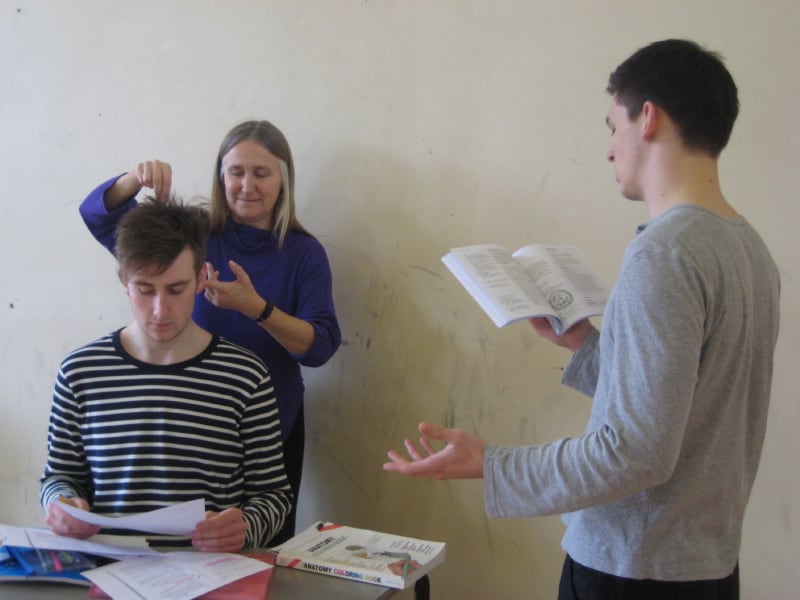
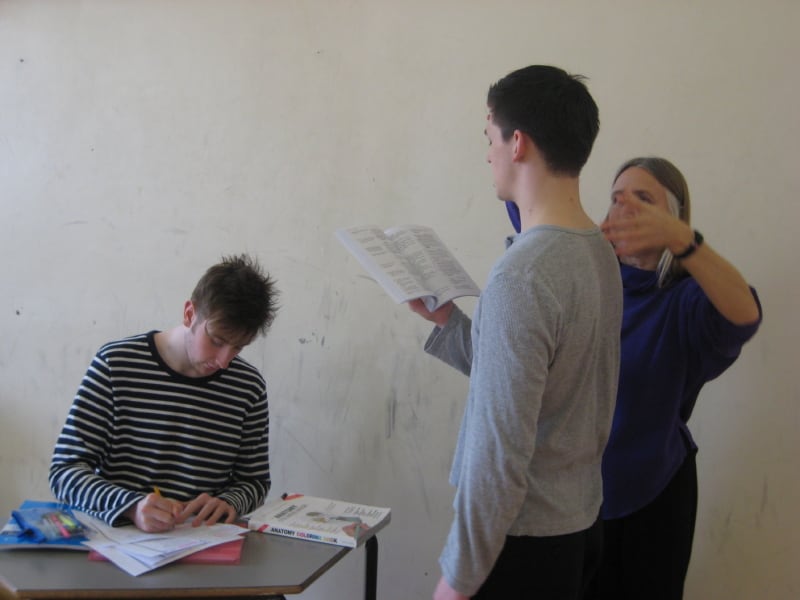
just in the same way you, Sue, stopped playing the character of your friend Kate, I’m going to talk to the inner actor inside you, your Higher Creative Self, and ask Higher Creative Self, can you stop being Sue. That’s right, you’ve been playing this character Sue for a long time, 20 years – it’s been a long run – that’s right you can let go of Sue’s history, her emotions, her beliefs, …..I guess the only emotion you have right now is wonder and curiosity……we honour Sue and the wonderful character and all she’s been through… she’s manifesting here right beside you , and if you want to drop back into being Sue again, anytime, you can…but just for now, I wonder what it would be if you let Sue go…that’s it. Sue likes to hold onto her legs a little bit, but you don’t have to do that anymore, Higher Creative Self…..and as you look about this room, it’s something Sue is very familiar with, but you’ve never seen it through your own eyes, Higher Creative Self, and all those people watching, yes that’s right, they are other people…, Sue knows them quite well, but you’ve never seen them through your own eyes before……….. I wonder what it would be like to walk as yourself, I wonder what it would be to explore this space….those things over there are chairs, that’s right you could take a look, and find out what it is to walk as yourself Higher Creative Self….
All the time I have been working with my hands on to liberate them from their use pattern, so as the actor begins to explore the space they may well be in a different experience. Sometimes they will just walk, sometimes touch things, sometimes I will sometimes encourage them to dance or run – generally it is a silent exercise and often they will look quite child-like.
When they have explored for a while, I’ll invite them back to the Transformational Vortex, and speak again
Higher Creative Self on you right is a person Sue knows quite well – her name is Kate – I wonder -what might be fun before you become Sue again, since you know Sue quite well, it might be fun for a moment to drop into being Kate instead and take Kate for a walk around the room…that’s right, just allow yourself to drop into being Kate……
The actor becomes Kate and walks around for a while. It is clearly the same Kate that they were pretending to be earlier, but the movement is fluid, whole, more organic.
I call ‘Kate ‘ to the Transformational Vortex and put my hands on, inviting Higher Creative Self to let go of Kate …..under my hands they reorganise their balance, their use. It is another opportunity for me to guide them ‘up’ and direct them.
Sue is waiting here on the left of you,, and it may be ok to go back into being Sue for a while. Now you’ve come up and out of Sue, you can always let her go whenever you want, but for now, it would be fine to drop back into Sue, so we can talk to her…
And sure enough they drop into their old use pattern….and often look bewildered, as to what on earth just happened!
We then discuss it as a group, what the audience noticed, what Sue was experiencing. Sue of course has had an Alexandrian turn – as she lets go of her personal history, and beliefs, she can let go of her fixed holding patterns, and has perhaps understood psycho-physical unity experientially. It is often quite a profound experience which they find difficult to put into words. The fellow students often perceive clearly how someone can transform their use, from character to character, and that their own personal use pattern is not something they want to take with them to every role they play.
Rather than going from habitual use to character , they go from habitual use to non-habitual use to character’s use.
It answers their question about how can they play a pulled down character without pulling down themselves – the HCS changes shape without pulling down.
I demonstrate with all of them one by one over the term.
Working on Hamlet 2
Not all of them will manage it well. Some pretend, which is fine – at least they are having a go, and it is still an exercise that may help them. One or two lose their ability to focus and laugh …it’s too profound for them to handle at this stage. I have also experimented with getting them all to do it as a group, but I believe it is more effective when they have the hands-on and the attention of me as the teacher and their fellow students watching. It is as important for the fellow students to see the transformation. When it works it is spell-binding. On one occasion, one of my students, Stefan, arrived with a heavy cold and lost it as he became his Higher Creative Self, the cold returning as the Higher Creative Self dropped back into being Stefan again.
When we have been through this process of choosing a person they know well for HCS to experiment with, I will use it again when they are playing a character – usually from their Chekov (Anton!) projects to begin with, and then have it as a tool to use throughout their time at ArtsEd.
During the workshop at Lugano, I demonstrated this exercise a couple of times. I asked the participants to think of a student they knew from their private practice, so we had quite an interesting selection of use patterns walking around the room! And having demonstrated hands-on at the Transformational Vortex a couple of times, the group divided into groups of three to experiment amongst themselves with this exercise. The Transformational Vortex, the words and the hands on all work together as a ritual. In the workshop in Lugano we had an interesting exchange about whether it was the neutral state that actors are asked to inhabit. (Actors are often asked to find a neutral state. Perhaps it is best described as the state before they take on a character or any emotions. In the traditional masks of theatre one shows the comic mask with the mouth turned up as though smiling, and the other, the tragic mask, the mouth turned down as though crying. The neutral mask however has the mouth straight depicting no emotions, and it is the skill of the actor that turns the mask into a character.) We agreed ‘neutral’ as a term to be unhelpful – it can mean lifeless, or blank. Higher Creative Self is anything but that. Higher Creative Self is playful, curious, full of wonder at the world it can at last experience fully, unhindered by the veil of habit, restriction and belief system.
I have used this exercise with some of my private non-acting students and has proved very fruitful for them too. Perhaps our job as Alexander teachers is to help all our students find that passage between habitual actor, to Higher Creative Self, so that the distance between the two is less and less anyway. Through the work we become more and more our ‘Higher Creative Self’ making choices as to what we do, how we do it and how we use ourselves, as a thinking emotional physical being.
Bibliography
www.wikepidia.com /Michael Chekhov 3rd August 2008
Chekhov, M. On the Technique of Acting 1991 [1985] Harper Collins, New York
Essays written by actors in training at Arts Educational London Schools about how Alexander has helped them.
These will be changed from time to time. ….
This is an extract of an essay written by Finn on BA acting for screen and stage course. Their assignment was to think in Alexander terms for a whole week and report their findings.
Alexander Technique Thinking Week
I perceived the technique to have a stage of completion, and once there, the body becomes a free and vigorous machine. I did not understand that it also involved mental learning. For example releasing tension, through thought of direction. To release unnecessary muscular stress that blocks our directions, we think of subtle changes of balance and alignment, which is different from conscious physical correction of our posture. I have always been reminded, during sessions, to, instead of physically alter a habitual resting position, I should ‘think’ and ‘direct’ the said tension, which should encourage a more easy, free and light way to do something. This was the concept that I found hard to grasp, but with time, and practice, I began to feel and notice the benefits of.
I found that the ‘Thinking week’ could not have come at a better time in the term. We are half way through our rehearsals for our contemporary play, Love and Money. I am playing David, in a fairly stationary scene, where I am emailing a love interest of mine, and end up spontaneously divulging more information than I would have liked. The scene suddenly becomes and extremely intense series of monologues, in which I was directed to stay sitting on my chair, however physically needing to show my stress levels rising with growing fear. I chose to start moving forward in my seat, and by the end of the scene, I found myself perched on the very edge, conveying an eager anticipation for a replying email. I was keen, having done so much work in Alexander technique classes on sitting and stand, to apply it in my scene. I looked at my notes from one on one sessions to remember exercises like the monkey, to remind me to hinge through the sit bones, before rehearsing I would talk myself into staying present, whilst breathing, so that I could remain open and responsive to the other actor on stage. I read notes, “when sitting my back felt tense, but Poppy [one of my assistants – ed] reminded me to think about my fingers coming away from my spine, with a releasing, following hand exercise, which took the pain away from my back” I remember my directions whilst coming to sit, thinking up through the head instead of bending through the waist and slouching onto the chair. With all this in mind I started the scene. I was privileged enough to be off book, so I could completely focus on my physicality. Incidentally, the feedback following the run had never been as positive as they were then. I was present and open, I managed to drive though the thoughts, and most importantly we communicated a story.
I accredit this to my tending of the Alexander Technique principles. I managed to maintain the fidgety and restless nature of David, but with my directions in mind. Because of this I found that I could really listen to the other actor. I have, during the course of the two years, been in many scenes which require me to simply listen and respond, as are most successful dramatic scenes, however I have never felt that ease I felt in the run-through, of just simply taking in what they are saying to me, and it came as a sort of pleasant shock. The exercises enabled me to stay present and released in the scene, which all came to me in an epiphanic way.
This is a piece written by Simon on the MA course.
Alexander Thinking Week
My Journey
Throughout this last week of Alexander thinking, the prominent issue that has struck me has been the subtle ease of movement I have felt and a greater sense of relaxation that I have been able to apply to my work. As to be expected, there have been periods over the week where I have experienced increased amounts of tension but, thinking in Alexander terms and applying those methods, I have been able to lose those tensions a lot quicker than I normally would and, as a result, the pressures on my body have been reduced.
Commuting in to school every day, the first area where I felt I could really apply the Alexander technique was on the train. Spending an hour and twenty minutes on the tube every day, it is very easy to drift off into one’s own world and I will admit that I am guilty of doing so. Thinking in terms of the unified field of attention, however, I have noticed a difference. By being aware of the space above and behind me and to either side of me, I have felt more alert and my eyes have certainly felt more energised in response to my surroundings. This is interesting as, when I first began commuting on a route that was unfamiliar to me, I was very much aware and alert to my surroundings but after the first week of this, the route very quickly became familiar to me and so I lost that sense of awareness and, looking back now, it is hardly surprising that this has led to feelings of tiredness and lethargy which often makes it more challenging to become energised for the day ahead. This week, however, even if I have had later nights, I have felt more energised in the mornings and ready to go. I often read on the train too or listen to music and, once again, it is very easy to get lost in this. I have continued these activities this week but, all the time whilst doing so, have been aware of the space above, behind and to either side of me. Spreading my field of attention like this has increased my sense of awareness but has also made commuting more exciting because one notices so many things that normally would go unnoticed and these things are interesting and spark the thoughts and awareness of the mind.
Whilst on the train, I have also been able to apply the technique when it comes to sitting and standing. It is often a dash to get to a seat on a busy train in the morning but this does not mean one has to be rushed in ones use. Inhibition also plays a part here. When spotting a seat, my initial reaction would be to dash over and sit down quickly which, inevitably is not the best use of myself. With this in mind, I would spot a seat, go over to it, inhibit my immediate response to sit and give myself a moment to think of my direction, to allow my neck to be free so that my back can lengthen and widen and my knees can go forward and away and my head goes forward and up before moving to sit. All this happens in a second so it doesn’t mean the pace of movement has to slow dramatically, just that a moment of thought can offer a more effective use. I was able to apply this when coming to standing too, especially when you are approaching your stop. You know you have to get off and so the muscles tense up in the knowledge of this as we think of coming to standing. Again, inhibiting this response and giving myself a moment to think of my direction, I was able to stand with a relaxed ease of movement that reduces the pressure on my body, particularly on my lower back. This has been something I have applied in all situations that require sitting and standing and it has been interesting to observe how free my lower back feels now in these sequences. Along with sitting and standing, just standing has been an interesting thing to observe. After the session we had in class where we experimented with the idea that the knees can bend and yet we don’t lose any height initially, I have been using this when standing and it has offered a more grounded support for my whole body and, once again, alleviated the tension in my lower back.
I have also been thinking about the idea of end gaining this week. This has come up at various points over the week and on some occasions I have been able to combat it whilst, at other times, I have end gained and then realised afterwards and so could recognise and address the issue. Going up and down stairs has been a factor in this thinking. Instead of thinking that I must either get to the top or bottom of a staircase, I have taken each step at a time and, as we were shown in class, imagined stepping into a box on each step. This has led to an ease and flow of movement that has felt more relaxed and reduced the tension on my thighs. I do remember at another time during the week where I had lost my pen and I was sitting in the object exercise room when someone moved the sofa and I noticed my pen on the floor. Without thinking, I immediately dashed across the room to retrieve it and, as a result, all Alexander thinking went out of the window and, as I sat down again with pen in hand, I realised that I had just totally and utterly end gained and so it was not surprising that when reflecting on this immediately after the action, I noticed that my body was full of a sudden build up of tension that had resulted in that sequence of movement. It was important to recognise this though as, before any Alexander work, I probably would not have thought anything of doing that and so I would have gone on to use myself in the same way, letting any tension go unnoticed.
As we continue to rehearse Shakespeare this week, one of my characters is Verges in Much Ado about Nothing. I have developed a physicality for him that involves a hunch of the back and this has led to a painful lower back on occasions during the process. By keeping the knees bent, moving forward and away, I have been able to find a better balance for myself in character which has reduced this tension. However, there is still tension around that area which is inevitable for the physicality and so I have been using other Alexander methods to ease this. Each night, before bed, I have spent twenty minutes on the floor in my bedroom in semi supine, allowing my body to release its tension from the day and to let my muscles ease into the floor and relax. This has also given me an opportunity to take note of my breathing and to carry out the meditation exercises that have then made it easier for my mind to relax and slow the thoughts that have been rushing around my mind, making it easier to drift off to sleep.
The Alexander technique continues to pleasantly surprise me. In this past week of Alexander thinking I have been left, on several occasions, thinking ‘yes…it really does work.’ Or, ‘I feel so relaxed.’ Or, ‘well that was easier than it normally is.’ The Alexander technique doesn’t require a major effort or definite action, but just a moment of thought to allow things to happen. At points in my Alexander thinking, I have found myself thinking that I should be doing something specific but, actually, as I have noticed this week, this is not so. A minimal approach can lead to big changes that can improve one’s use dramatically.